Sargassum in Playa del Carmen: Season, Alerts and Where to Swim
Sargassum in Playa del Carmen usually arrives from late March, peaks between May and August and tails off through October. In 2025 the state hauled a record 92,782 tonnes off Quintana Roo beaches, so the seaweed is real, but it is a shoreline problem. Boat tours from Playa del Carmen keep running all season because the water a few hundred meters offshore is clear.
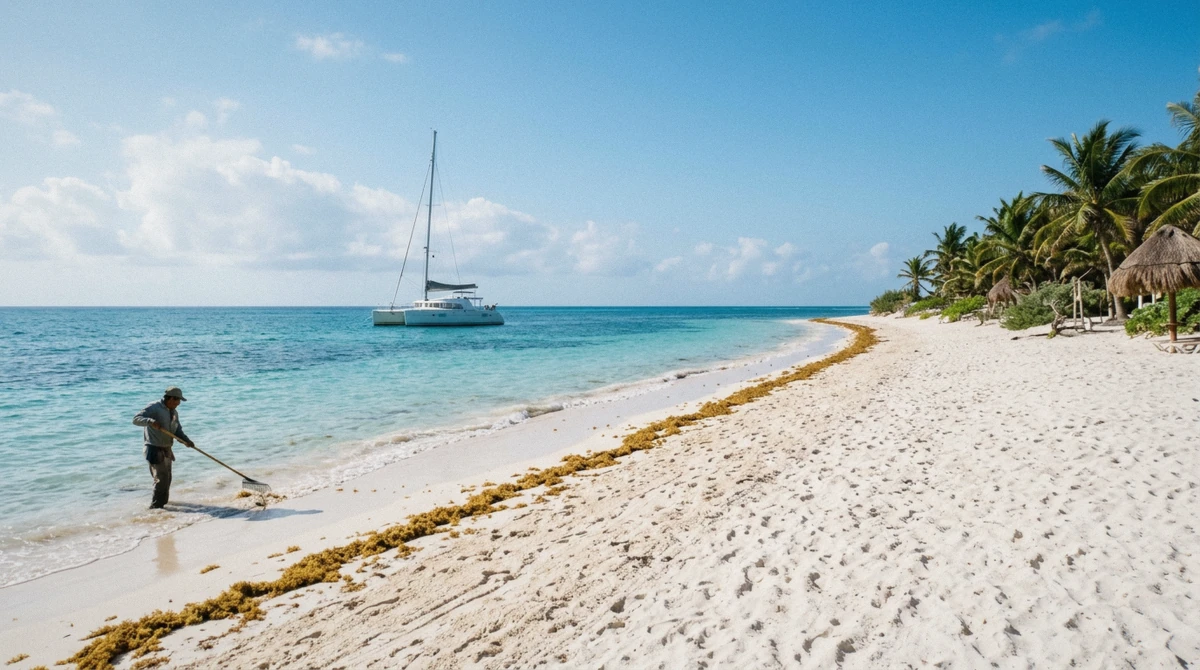
The weed piles up on the shore. A few hundred meters out the water is usually clear.
Quick answer
Sargassum season in Playa del Carmen normally starts in late March or April, peaks in May to July and fades by October. Quintana Roo collected a record 92,782 tonnes in 2025, and the 2026 season ran larger still. The seaweed lands on the shore, not on the water where boats sail. Check the state monitoring network and the Navy's alert colours before you head out, then head for Cozumel's west coast or Isla Mujeres if your beach looks brown.
Key takeaways
- Cozumel's west coast stays clean in most weeks thanks to local currents, and a round-trip ferry gets you there in about 35 minutes each way
- The El Cielo catamaran sails from Cozumel to sandbars the mainland seaweed never reaches
- The Isla Contoy and Isla Mujeres day is the longest escape, eight hours heading north away from the weed belt
- Our full guide to snorkeling in Playa del Carmen covers in-town reefs for calm-sea days
- Punta Esmeralda, Playa del Secreto and Xcalacoco, north of downtown, tend to stay cleaner than the beaches by Fifth Avenue
Boat Trips to Clearer Water
The simplest answer to a brown beach is to leave it, and these trips do exactly that. {checked}
 from $74
All-Inclusive Catamaran
from $74
All-Inclusive Catamaran
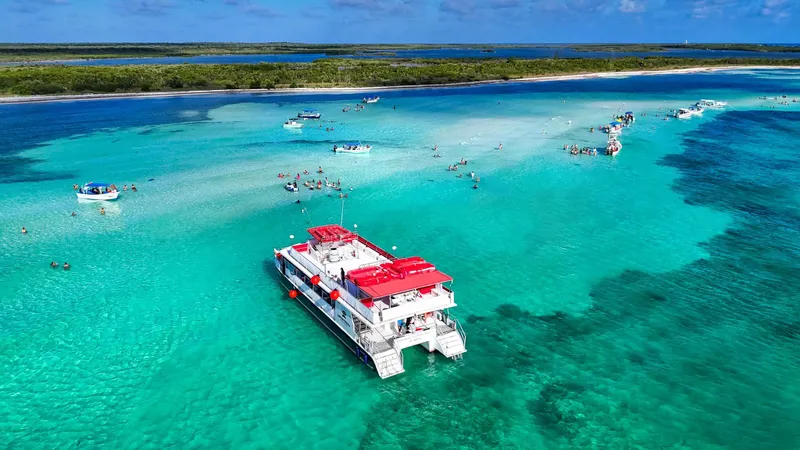
Cozumel: VIP Catamaran with El Cielo, Reef & Open Bar
A five-hour day on a 72-foot catamaran out of Cozumel, with snorkeling at a protected reef and stops at the El Cielo and Cielito sandbars. Open bar, lunch…
- Anchor at the El Cielo and Cielito sandbars
- Snorkel a protected Cozumel reef
- Open bar and lunch on board
- 72-foot catamaran, five hours from Cozumel
 from $38
Most Booked Crossing
from $38
Most Booked Crossing
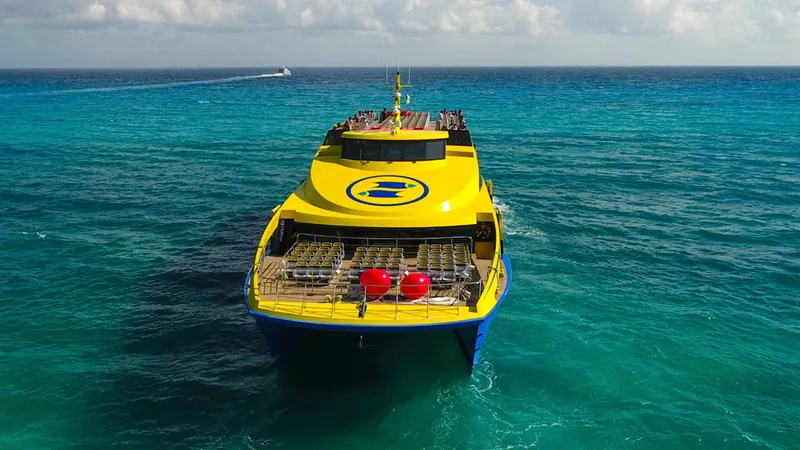
Playa del Carmen: Round-Trip Ferry to/from Cozumel
Ultramar's open round-trip ticket between Playa del Carmen and Cozumel on its 157-foot catamaran ferries, with air-conditioned cabins, open decks, a snack bar and live music. The ticket…
- Ultramar ferry, about 35 minutes each way
- Open round trip, valid six months
- Air-conditioned cabin plus open-air deck
- Deck tax included in the price
 from $179
Island Hopping
from $179
Island Hopping
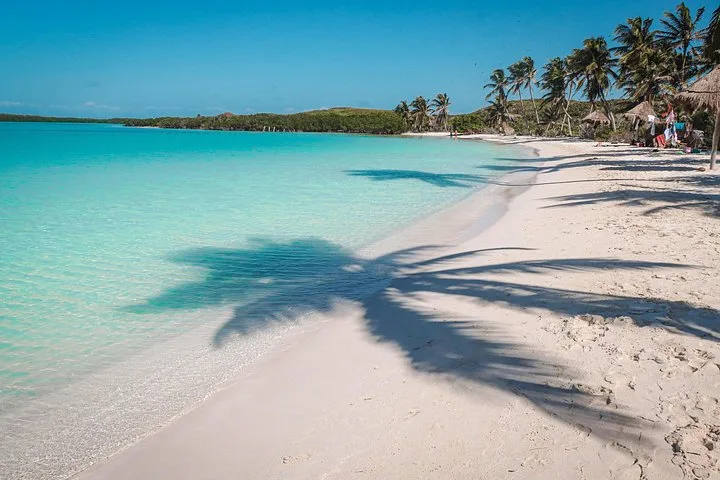
Isla Contoy & Isla Mujeres: Boat Day with Snorkeling
A full boat day to Isla Contoy, the protected bird island north of Isla Mujeres, then on to Isla Mujeres with a reef snorkel and lunch. Round-trip transport…
- Landing on protected Isla Contoy
- Reef snorkel and time on Isla Mujeres
- Lunch, water, soft drinks and beer
- Round-trip transport included
The Season Month by Month
When the seaweed arrives and leaves
Sargassum season in Playa del Carmen starts in late March or April, when the first landings from the Great Atlantic Sargassum Belt reach the coast. The peak runs from May to June, and some years it stretches into July or even September. The tail end comes in September and October, when landings slow but do not always stop.
In a heavy year the state stoplight can turn red by late May, and moderate landings can carry on into the first week of October. The table below shows the pattern to expect.
| Months | What usually happens |
|---|---|
| January to March | Low risk, though Isla Mujeres has seen an atypical winter landing |
| Late March to April | Season usually opens. First rafts drift in with south and southeast currents |
| May to June | Peak season in most years, when the stoplight can turn red |
| June to September | Strongest stretch in some forecasts. Daily cleaning crews and barriers work flat out |
| September to October | Season tails off, though in heavy years most monitored beaches still show some weed |
| November to December | Off season. Beaches are normally clear and booking a boat trip is easy |
How much seaweed is coming
The volumes have grown. A paper in Scientific Reports reported that more than 70,000 tonnes of sargassum per day reached tropical North Atlantic coasts at the peak, with the Caribbean worst hit. The University of South Florida's Optical Oceanography Lab says 2025 set the Atlantic biomass record at roughly 37.5 million tonnes, and 2026 was forecast to beat it before its August update placed 2026 second all-time for daily tonnage.
On the ground, the numbers tell the same story, and each figure below comes from its own source.
| Figure | What it covers |
|---|---|
| 92,782 tonnes | Collected across Quintana Roo in 2025, a state record (24 Horas Qroo) |
| More than 123,400 tonnes | Collected across Quintana Roo in 2026, counted up to early September, about a third above all of 2025 and the largest volume recorded (SEMAR via 24 Horas Qroo) |
| 40,000 to 50,000 tonnes | Typical historical annual baseline for the state, per a state official |
| More than 35,000 tonnes | Removed from Playa del Carmen alone in 2026 (municipality) |
| More than 30,000 tonnes | Removed from Playa del Carmen in 2025, the decade high for the municipality |
Why it comes here at all
Since 2011 a mat of sargassum has formed each year between West Africa and the Caribbean, pushed west by equatorial currents. The mainland coast of the Riviera Maya faces east straight into its path. Playa del Carmen is open to the open sea with no sheltering headland, so the downtown beaches by Fifth Avenue take the brunt while elsewhere on the coast geography helps.
That is also why the islands, which sit out of the direct drift, often stay clear.
How to Check Today's Seaweed
The state monitoring network
Quintana Roo runs the Red de Monitoreo del Sargazo, a monitoring network that started as a Facebook group run by civil society and is now operated by the state environment secretariat. It covers 140 monitoring points, 100 in the north zone and 40 in the south, up from just 20 in 2015. Reports come out regularly and rate each beach on its own, which is what makes them useful.
- Find the day's Red de Monitoreo del Sargazo report from the state environment secretariat before you pick a beach
- Read your specific beach, not the whole coast. Readings change beach by beach
- Green or blue on the stoplight means none or low, yellow is moderate, orange is abundant, red is excessive
- A red stoplight on your beach means switch beaches that day. Nearby coves can differ by a few hundred meters
- Check the SEMAR bulletin too. The Mexican Navy publishes daily and weekly sargassum reports with an alert level for the whole state
The Navy's alert colours
SEMAR issues its own alert level for Quintana Roo on top of the beach-by-beach stoplight. The alert covers Solidaridad, the municipality that includes Playa del Carmen, and Cozumel separately. Yellow means landings are still happening but the situation is managed, so you can plan around it rather than cancel.
Use the Navy level for the big picture and the state stoplight for the beach in front of your hotel. Between the two you will know more than most people on the sand.
- The network is your best tool, since the colours come from people standing on each beach
- Hotspots in Playa del Carmen itself tend to be Playacar, Playa Fundadores, El Recodo and Playa Golondrinas, right where the town is open to the sea
- The municipality runs about 300 workers on the sand in season, around 150 Zofemat and 150 Navy, plus 5 kilometers of floating barriers from Playa Cisne to Punta Esmeralda and 15 collection points
- SEMAR works further out, with satellite monitoring, containment barriers and vessels that gather sargassum at sea before it lands
Where It Stays Clearer
Cozumel's west coast
Cozumel is the most reliable escape. The island's west coast faces the channel toward Playa del Carmen, and the currents and tides that dump weed on east-facing mainland beaches sweep its shores clean. The island's Zofemat director has reported the west-side beaches free of sargassum even in the middle of a record year.
The east coast is a different story. Beaches like San Martín catch the arrivals directly, and crews have removed 8 to 10 tonnes a day there in peak weeks. So when people say Cozumel has no sargassum, they mean the west side, which is exactly where the ferry docks and where the catamarans to El Cielo sail from.
For how the crossing works, see our page on the Playa del Carmen to Cozumel ferry.
Isla Mujeres and Playa Norte
Playa Norte on Isla Mujeres sits in a sheltered north-north-west bay and is normally one of the clearest beaches on this coast. It is not immune. In one atypical winter landing the island government removed about 30 tonnes from Playa Norte.
So the caveat matters: Playa Norte is usually clear in normal winds, but check the state report before you commit a day to it. Further afield, sargassum.today names Xpu-Ha, Akumal, Paamul and Puerto Morelos as mainland spots that often stay cleaner, and Holbox as another island day trip. Our Isla Contoy tour guide covers the protected bird island north of Isla Mujeres, which sits well away from the usual drift.
Why the mainland gets hit
Playa del Carmen's beaches face east into the sargassum belt's drift with nothing between them and Africa. The downtown stretch takes the most because it is the most exposed. North of town the geography changes.
Punta Esmeralda, Playa del Secreto and Xcalacoco sit behind slight shelter and tend to be cleaner, as does Punta Maroma further along. The floating barriers the municipality stretches from Playa Cisne to Punta Esmeralda exist to hold rafts offshore where boats can collect them before they rot on the sand. None of this is a guarantee, which is why the stoplight report beats any rule of thumb.
Is It Harmful?
Fresh seaweed versus rotting piles
Fresh sargassum floating in the water is not toxic on contact, though it can irritate sensitive skin, so a swim through a thin raft is unpleasant rather than dangerous. The rotten-egg smell that gives the season its bad reputation comes from piles decomposing on the beach. Rotting sargassum releases hydrogen sulfide, methane and ammonia, and researchers put it simply: the more sargassum, the more decomposition.
A fresh beach with daily cleaning is a very different environment from a beach with a week-old heap baking in the sun.
Who is actually at risk
The serious exposure numbers come from the people working the piles, not the tourists beside them. A UNAM study measured hydrogen sulfide at about 1.8 ppm on sargassum collection boats in Puerto Morelos, Playa del Carmen and Mahahual during the 2025 landings, above the roughly 1 ppm limit for work shifts. Collectors have recorded skin itching and burning, headache, dermatitis, nausea, throat irritation and breathing difficulty, and the researchers' framing is that chronic exposure drives the risk, not a one-day visit.
For a traveller the practical advice is short: do not walk through or handle rotting piles, keep children and pets off them, rinse off after swimming near weed, and pick a beach the stoplight says is green or yellow if the smell bothers you. Asthmatic travellers should give stinking beaches a wide berth and swim elsewhere that day.
What It Means for Boat Trips
The boats run all season
Catamaran and snorkel tours keep operating from Playa del Carmen straight through sargassum season. The boats leave from the pier and head out past the weed line, and the floating mats are patchy and shift with the wind rather than covering the sea. No official source documents how the season affects reef visibility on local snorkel trips, so we will not claim a number there.
What you see from the deck is simple: the water a few hundred meters offshore looks like the postcards while the beach behind you looks brown. That is the whole reason a boat day is the best answer to a bad stoplight.
The islands are the escape route
The trips that sell best in heavy season are the ones that end up on the sheltered side of an island. Cozumel's west coast, where the El Cielo sandbars sit, stays clean even in record years because of its currents. Playa Norte on Isla Mujeres is normally just as clear, with that atypical winter landing as the standing reminder that no beach is guaranteed.
If your week falls in the peak, book the island trips early and treat the mainland beach as the bonus rather than the plan.
Whale shark trips are unaffected
The whale shark feeding grounds off Isla Mujeres sit 15 to 25 miles offshore in deep water, far beyond where coastal sargassum reaches. Whale shark trips run normally all season, which makes them one of the few summer plans you can book without checking a stoplight first. The season for them runs in the same summer months as peak sargassum, so the deep water offset is a genuine stroke of luck for travellers.
If the Beach Is Covered
If You want clear water and starfish under your fins
Take the El Cielo catamaran from Cozumel, five hours of shallow sandbars and a protected reef on the island's clean side
If You just need to get off the mainland for the day
Ride the round-trip Ultramar ferry across the channel and walk Cozumel's west-coast beaches on your own schedule
If You want a full day far from the weed belt
Book the Isla Contoy and Isla Mujeres boat day, eight hours north with a reef snorkel and lunch included
If You would rather stay in town and still get in the water
Read our guide to snorkeling in Playa del Carmen for reefs and entry points that work on a yellow-flag day
Sargassum Questions
When does sargassum season start and end in Playa del Carmen?
The season usually opens in late March or April, peaks from May to June, and in some years runs strongest into September. It tails off through September and October. In heavy years moderate landings carry on into the first week of October, so treat October as part of the season rather than the end of it.
How do I know if there is seaweed on my beach today?
Check the Red de Monitoreo del Sargazo de Quintana Roo, the state network that reads 140 beaches and publishes a stoplight colour for each one. Green or blue means none or low, yellow is moderate, orange is abundant and red is excessive. The Navy's SEMAR bulletin gives a second opinion with an alert level for the whole state. Read the report the morning you plan to swim, since conditions change daily with the wind and currents.
Where can I find water without sargassum near Playa del Carmen?
Cozumel's west coast is the most reliable, and it stays free of sargassum even in record years thanks to its currents. Playa Norte on Isla Mujeres is normally very clear in its sheltered bay, though it once took an atypical 30-tonne winter landing, so no beach is guaranteed. On the mainland itself, Punta Esmeralda, Playa del Secreto, Xcalacoco and Punta Maroma tend to be cleaner than the downtown beaches.
Is it safe to swim in the sea when sargassum is present?
Fresh floating sargassum is not toxic on contact, though it can irritate sensitive skin. The health concern is the rotting piles on the sand, which release hydrogen sulfide, methane and ammonia as they decompose. A UNAM study measured hydrogen sulfide at about 1.8 ppm on collection boats during heavy work, well above a full work-shift limit. Swimmers face nothing like that exposure. Avoid touching or walking through old piles, rinse off after your swim and choose a cleaner beach if the smell is strong.
Do boat tours still run during sargassum season?
Yes, catamaran and snorkel tours operate from Playa del Carmen all season. The weed is a shoreline problem and the mats offshore are patchy and move with the wind. The trips that suffer least are the island ones, because Cozumel's west side and the grounds north of Isla Mujeres sit outside the coastal drift. The whale shark zone is 15 to 25 miles offshore in deep water, so those trips run normally too.
Which months should I skip if I hate seaweed?
If sargassum ruins a beach day for you, avoid the May to July stretch, which peaks most years, and expect some presence from late March through October. November to March is the easy window, when beaches are normally clear and you can book a Cozumel catamaran day without checking any report first. Winter travellers trade a small risk of cool north winds for clean sand.
How bad did the 2026 season get compared to other years?
It was the largest volume recorded for the state. SEMAR figures put Quintana Roo collections above 123,400 tonnes by early September, roughly a third above all of 2025, which itself set a record at 92,782 tonnes. A state official gave a typical historical baseline of 40,000 to 50,000 tonnes a year. The University of South Florida ranked 2026 second all-time for daily tonnage reaching beaches, after its own biomass record year in 2025.
Can I still reach Cozumel easily if my Playa del Carmen beach is brown?
Very easily. The Ultramar ferry crossing takes about 35 minutes each way, with air-conditioned cabins, open decks and a snack bar on 157-foot catamaran ferries. A round-trip ticket stays valid for six months, departures run continuously all day and the deck tax is included in the fare. The ferry docks on Cozumel's west coast, the side the currents keep clean, so you step off into the good water.