Whale Shark Tour from Playa del Carmen: Season, Prices and the Rules in the Water
A whale shark tour from Playa del Carmen is a full-day summer trip that runs only from May 15 to September 17, the official window set in the federal management plan for the Mexican Caribbean. The sharks feed far offshore, north-east of Isla Mujeres and Isla Contoy, so the day runs 7 to 12 hours door to door. Outside those dates no legal swims run, so the time to book is before the next May 15 opening. This page is part of our Playa del Carmen boat tours guide and covers the season month by month, the rules in the water, the cash fees nobody mentions and an honest comparison of the two swims we rate.
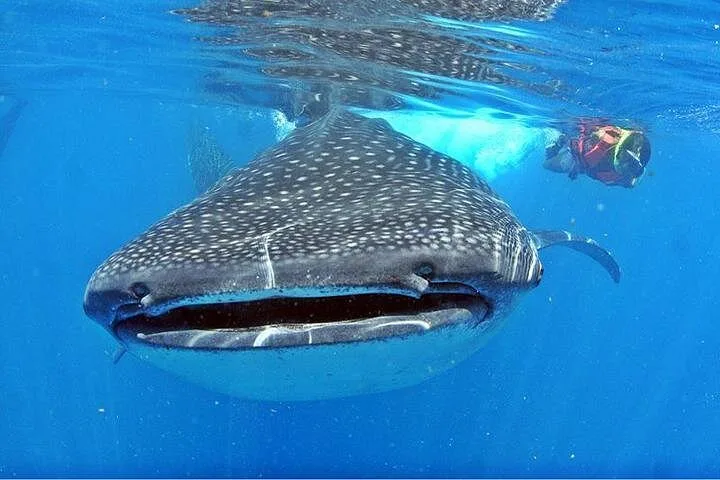
Quick answer
The whale shark season near Playa del Carmen runs May 15 to September 17, with peak activity in July and August. A tour from Playa del Carmen takes 7 to 12 hours door to door because the boats leave from piers around Cancún and the feeding zone sits 15-25 miles offshore. Only two swimmers plus a guide may be in the water per boat, keeping at least 5 meters from the shark. Outside the season no swims run, so book ahead for the dates from May 15.
Key takeaways
- Official season: May 15 to September 17, per the federal management plan.
- Whale Shark Swim with Pickup in Playa del Carmen takes groups of up to 10 and costs $199 plus $25 cash in fees.
- Whale Sharks: Swim with Pickup in Playa del Carmen costs $160 plus a $20 cash fee and runs 8 hours.
- Sargassum does not reach the deep offshore feeding zone, so the sargassum guide matters only for your beach days.
- No operator guarantees a sighting. Both tours we list say so plainly in their own terms.
The Swim at a Glance
May 15 to September 17 every year under the current management plan, with July and August the busiest months for sharks.
Boats depart from marinas on Cancún's Puerto Juárez-Punta Sam corridor and run to the feeding grounds north-east of Isla Mujeres, Isla Contoy and Isla Holbox.
Expect 7 to 12 hours door to door from Playa del Carmen, with roughly 5 hours of that on the boat.
Surface snorkeling only, two swimmers plus a guide in the water at a time under the management plan, no scuba, life vest mandatory.
Both tours collect a cash fee at pickup, $25 per person on one and $20 on the other, covering federal marina and park charges.
Spotting is done by eye from the boat because sonar is banned, so you may see one shark, several, or none.
The Two Whale Shark Swims
Two seasonal swims from Playa del Carmen make our shortlist for the coming season.
from $199
Small-Group Whale Sharks
Whale Shark Swim with Pickup in Playa del Carmen
A summer-season whale shark swim in the open water off Cancún and Isla Mujeres, in groups of up to 10, with pickup from Playa del Carmen hotels. Ceviche…
- Groups of up to 10
- Pickup from Playa del Carmen
- Ceviche and coffee break included
- Season runs May 15 to September 17
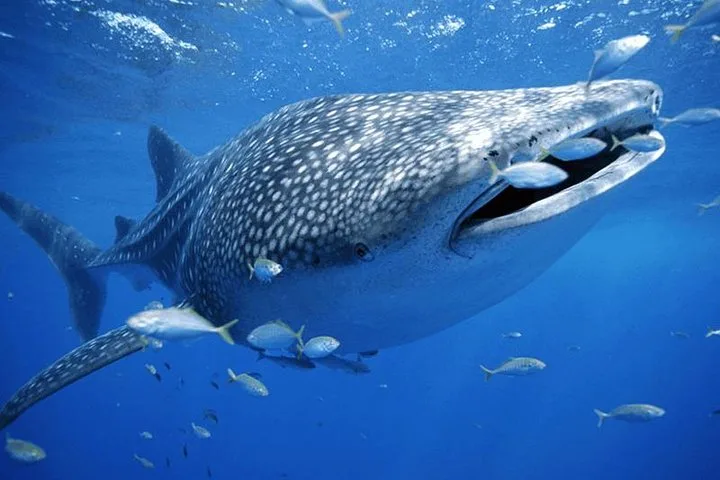 from $160
Whale Shark Swim
from $160
Whale Shark Swim
Whale Sharks: Swim with Pickup in Playa del Carmen
A summer-season whale shark swim in the open water off Cancún, with a bilingual naturalist guide, snorkel gear, ceviche and sandwiches, and shared pickup from Playa del Carmen…
- Bilingual naturalist guide
- Snorkel gear and life jacket included
- Ceviche, sandwiches and soft drinks
- Season runs May 15 to September 17
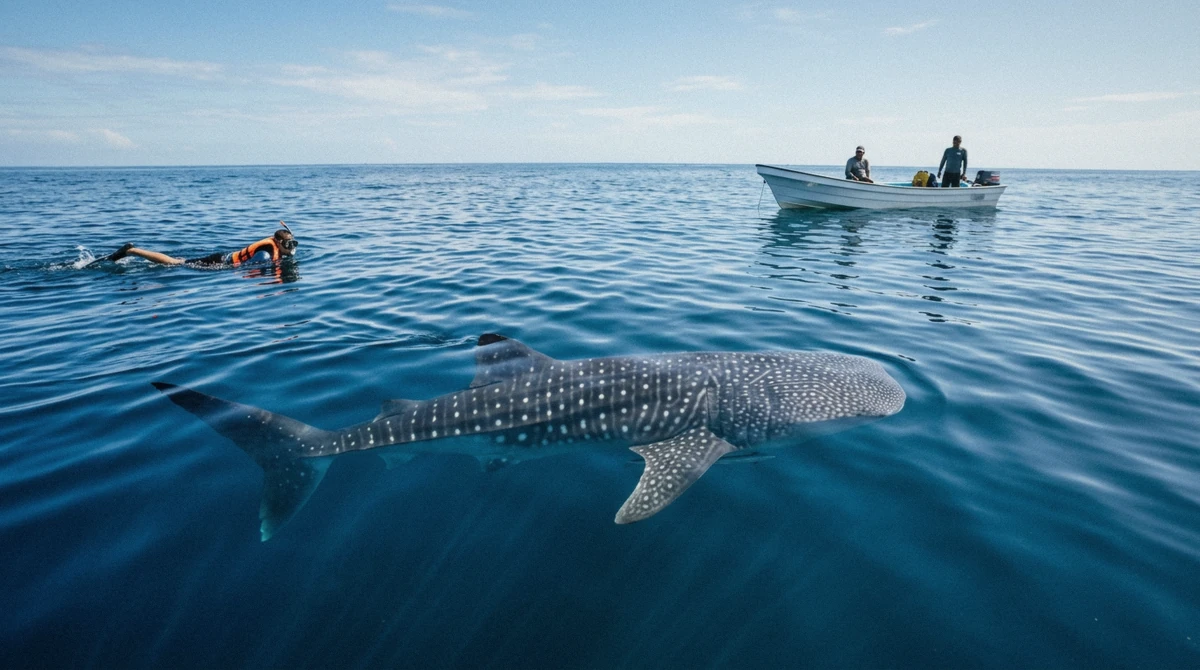
Guides keep swimmers several meters from the shark and rotate pairs in and out of the water.
The Season, Month by Month
The official dates
The official observation and swimming period in the Mexican Caribbean is May 15 to September 17, fixed in the SEMARNAT management plan that covers three consecutive seasons on the same dates. CONANP announced the opening of the season on May 15 with a press release, and the sharks approach the peninsula roughly May through September. Outside that window no authorised whale shark swims operate at all, so if you read about a whale shark trip running in October or April, it is not a legal one.
When the sharks are thickest
Peak activity falls in July and August. The densest aggregation recorded came in a 2009 aerial survey, when researchers counted 420 whale sharks in about 18 square kilometers, the largest aggregation known at the time, in a PLOS ONE study. The sharks gather where bonito spawn at the surface, at a spot local fishermen call Afuera, north-east of Cabo Catoche.
Early June and mid-September still produce sightings, but the odds of a wide-open feeding frenzy are best in the middle of the season.
Month by month expectations
The table below compares what the season typically delivers, based on the official window and the aggregation studies. Note that one operator, Ocean Tours Mexico, describes its own season as June to mid-September, which is narrower than the official window that opens May 15. Ask your operator which dates they actually run before booking the edges of the season.
| Period | What to expect |
|---|---|
| May 15 to May 31 | Season opens. Sharks are arriving and sightings are possible but less consistent than in high summer. |
| June | Numbers build. Some operators only start running from this month even though the official window opened earlier. |
| July to August | Peak activity. This is when the densest aggregations historically form offshore, and when boats most often find multiple sharks feeding. |
| Late July to mid-August | Historically the densest stretch of the whole season for the offshore aggregation. |
| September 1 to 17 | Season winds down and closes on September 17. After that date no authorised swims run until the next May 15. |
| September 18 to May 14 | Season closed. No legal whale shark tours operate anywhere in the Mexican Caribbean. |
Where the boats actually go
Two aggregation areas are managed in the north Caribbean, the Whale Shark Biosphere Reserve and a zone called El Azul inside the Mexican Caribbean Biosphere Reserve, and since 2009 most sightings have come from El Azul. The tour zone sits between Isla Mujeres, Puerto Juárez, Chiquilá and Isla Holbox, north-east of Isla Contoy, the bird island you can visit on a separate day trip. That offshore position is why the day from Playa del Carmen is long, and it is also why sargassum is not a problem for these trips, since the sharks feed in deep water well past where the seaweed drifts.
How the Day Runs from Playa
Pickup to the pier
Playa del Carmen sits about 65 kilometers in a straight line from Puerto Juárez in Cancún, and by road with hotel pickups the drive runs an hour or more depending on traffic and time of day. Both tours we list collect you from your Playa del Carmen hotel in the morning, and both also sell a cheaper option where you make your own way to the pier in Cancún. If you skip the transfer, one operator meets you at Flamingos Seafood Kitchen on the Puerto Juárez-Punta Sam road and the other at Marina Xtabay, both in the same corridor.
The marinas are inspected at the pier before departure, where authorities check passenger counts, life vests and wristbands.
Out to the feeding zone
From the pier the boat runs north-east toward the area between Isla Mujeres, Isla Contoy and Isla Holbox. The sharks feed 15-25 miles offshore, so the ride out takes a while and the sea can be open and choppy. Spotting is done with binoculars and by eye, because sonar and echo-sounders are banned in the zone.
Once a shark or a feeding group is found, boats approach from behind at under 3 knots, cut the engine within 30 meters, and only one boat works a shark at a time while the rest wait 50 meters away.
Time on the water and the trip home
Official in-water hours run from 7:00 to 14:00, so the swim window itself is a morning affair. On the water expect about 5 hours total, with swims taken in short rotations while your group waits its turn. The day comes in at 7 to 12 hours door to door for the tour that lists that range, and 8 hours for the other.
Back at the pier you get food, one tour serves fish or shrimp ceviche with a coffee break, the other ceviche, sandwiches and soft drinks, then the van returns you to Playa del Carmen. The waiting periods with engines off are where seasickness hits, so if you are prone, ask your doctor about medication before the day.
- Morning pickup at your Playa del Carmen hotel, exact time sent the day before
- Road transfer of roughly an hour or more to the Cancún pier area
- Pier check-in, passenger count and life vests verified
- Boat ride of 15-25 miles offshore to the feeding grounds
- Morning swim window, official in-water hours run 7:00 to 14:00
- Ceviche, drinks and the ride back to the pier
- Van back to Playa del Carmen, full day 7 to 12 hours
The cash fees, explained
Both tours quote a per-person price and then collect a cash fee at pickup, which surprises people on the day. One charges $25 per person in cash for federal marina and national park fees, the other $20 in cash for an environmental tax and dock use. For reference, the conservation bracelet for the Whale Shark Biosphere Reserve alone is listed by CONANP at 225 MXN per person per day, which works out to $12.39 (225 MXN), and children under 12 are exempt from that bracelet.
The tour fees cost more than the bracelet alone because they bundle the marina and dock charges on top.
Rules in the Water
How many swimmers and how close
The management plan allows only two people plus one guide per boat in the water at a time, at a minimum of 5 meters from the shark, with no physical contact of any kind. A separate federal standard, NOM-171-SEMARNAT-2018, words it differently, letting a guide control up to five users in the water and setting distances of 2 meters from the head and 3 meters from the tail. The two documents disagree, and the stricter local authorisation governs, so good guides follow the stricter reading of 5 meters from the head and 6 meters from the tail.
Each boat gets a maximum of 30 minutes around a shark or group before rotating out.
What is banned
The code of conduct, Observo, No Toco, means observe, do not touch. No touching, riding, feeding or blocking the shark's path. Flash and artificial light are banned, as are selfie sticks, drones, scooters, kayaks, jet skis and noise devices, and no alcohol before or during the trip.
Sunscreen is the confusing one, because the plan prohibits all sunscreen in the water zone while the conduct code only bans non-biodegradable products, and operator texts differ too. The safe advice is to wear none and use a rash vest instead, applying any biodegradable product only before transport or after the water activities.
Gear and boat limits
A full-chest life vest, snorkel, fins and mask are mandatory for every swimmer and the guide, and snorkeling at the surface is the only method allowed, no scuba. Boats in the zone may be up to 11 meters long, must approach from behind at under 3 knots with the engine in neutral within 30 meters, and only one boat works a shark at a time. The exact number of passengers and swimmer rotations per boat is set by each operator's CONANP authorisation and the boat's safety certificate rather than a single national number, which is why one tour caps groups at 10 and the other does not publish a cap.
Operators must carry their authorisation, display their flags on the boat and brief every guest before the first swim.
See What the Swim Looks Like
Which Swim to Book
The two tours compared
Both tours cover the same water, the same season and the same rules, so the choice comes down to group size, food and price. The table below compares the two swims we rate side by side, card price, cash fee, group size and what is included. Both collect a full refund if you cancel at least 24 hours before departure, and both cancel with a refund if the weather turns.
| Swim | Price | Cash fee | Group | Includes |
|---|---|---|---|---|
| Whale Shark Swim with Pickup in Playa del Carmen | $199 per person | $25 per person in cash at pickup | Up to 10 | Pickup in Playa, bilingual guide, fish or shrimp ceviche with totopos and guacamole, coffee break, snorkel gear |
| Whale Sharks: Swim with Pickup in Playa del Carmen | $160 per person | $20 per person in cash on the day | not stated | Shared pickup in Playa, bilingual naturalist guide, snorkel gear and life jacket, fish ceviche, sandwiches, water and soft drinks |
Honest notes before you pay
Neither tour guarantees a sighting. One states that swimming cannot be guaranteed and may be limited to viewing from the boat, and the other says it cannot guarantee a sighting but will do everything to maximise your chances. Neither publishes a refund-for-no-shark policy, so treat the trip as a boat day that usually delivers sharks, not a promise.
Age limits differ. The $199 tour takes children from 3 to 11 with adults 12 to 75, and warns against it for pregnant travelers, spinal injuries or poor cardiovascular health. The $160 tour takes ages 5 to 99. Both offer a private option if you want the boat to yourselves. One final warning, the review counts are strong, a 4.8 from 1,286 reviews against a 4.6 from 1,017, but ratings measure the operator, not the sharks.
From Playa to the Feeding Grounds
The places this page talks about, pinned. Tap a pin for directions.
Whale Shark Questions from Playa del Carmen Travelers
When is whale shark season near Playa del Carmen?
The official season runs May 15 to September 17, the same dates every year under the current federal management plan for the Mexican Caribbean. Peak activity falls in July and August, with the densest aggregations historically late July to mid-August. Outside that window no authorised whale shark swims operate, so any tour offered in autumn, winter or spring is not running legally.
How long is the whale shark tour from Playa del Carmen?
Plan for a full day. Door to door it runs 7 to 12 hours depending on your pickup point and where the sharks are feeding, with one operator listing its trip at 6-10 hours and the other at 8 hours. The drive to the Cancún pier area takes about an hour or more, the boat ride out covers 15-25 miles, and official in-water hours end at 14:00. The sharks gather far offshore north-east of Isla Mujeres and Isla Contoy, which is what makes the day long.
How close can you get to a whale shark?
Official rules set a minimum distance rather than a maximum. The management plan requires swimmers to stay at least 5 meters from the shark, and the code of conduct specifies 5 meters from the head and 6 meters from the tail, with no physical contact whatsoever. Boats must stop 5 meters away with the engine in neutral and get a maximum of 30 minutes per shark. Guides follow the stricter figures because the local authorisation governs.
Are whale sharks guaranteed on the tour?
No, and honest operators say so. One swim on this page states that swimming cannot be guaranteed and may be limited to watching from the boat, and the other admits it cannot guarantee a sighting, only work to maximise your chances. Neither publishes a refund policy for trips without sharks. Spotting is done by eye because sonar is banned, so odds are best in July and August but never certain.
Can kids swim with whale sharks?
Yes, with age limits that differ by operator. The $199 tour takes children aged 3 to 11 alongside adults aged 12 to 75 and warns against it for pregnant travelers, spinal injuries or poor cardiovascular health. The $160 tour accepts ages 5 to 99. Every swimmer, child or adult, must wear a full-chest life vest, and only two swimmers plus a guide are allowed in the water at a time under the management plan, so kids wait their turn on the boat.
Why do I have to bring cash to a prepaid tour?
The card price does not include the federal charges. One tour collects $25 per person in cash at pickup for federal marina and national park fees, and the other collects $20 in cash for an environmental tax and dock use. For comparison, the conservation bracelet for the biosphere reserve alone is listed at 225 MXN per person per day, about $12.39, so the tour fees bundle the bracelet together with marina and dock charges. Bring extra cash for tips and souvenirs too.
What should I bring on a whale shark swim?
Bring a swimsuit, towel, hat, sunglasses and light clothing, plus cash for the fees and tips. Snorkel gear and life jacket are provided on both tours, though you can bring your own mask if you prefer. Do not wear sunscreen into the water, the management plan bans it in the zone, so use a rash vest for sun protection and apply biodegradable product only before transport or after swimming. If you get seasick, ask your doctor about medication before the day, because waiting with engines off is where it hits.
Is the whale shark tour affected by sargassum?
No. The sharks feed 15-25 miles offshore in deep, open water where the sargassum does not accumulate, so whale shark tours run normally through the sargassum season. Sargassum is a beach concern, not a whale shark concern, and the sargassum guide covers what it means for your hotel days in Playa del Carmen.